

Open channels are found everywhere—from municipal water treatment plants to agricultural irrigation systems, environmental monitoring networks, and wastewater management facilities. Whether you’re managing a river, canal, drainage ditch, or partially filled pipe, accurate flow measurement is essential for regulatory compliance, operational efficiency, and resource management. But with so many measurement methods available, how do you choose the right one?
This guide explores the most common and modern approaches to open channel flow measurement, helping you understand their strengths, limitations, and best applications.
What Makes Open Channel Flow Measurement Unique?
Unlike closed pipes where water flows under pressure, open channels feature a free surface exposed to atmospheric pressure.
This fundamental difference means traditional closed-pipe flow meters won’t work—you need specialized methods and equipment designed specifically for these conditions.
The challenge is that open channel flows are inherently variable. Water depth, velocity, and conditions constantly shift, making consistent, accurate measurements more complex than you might expect.
Getting it right, however, pays dividends through better operational control, improved compliance reporting, and smarter water management decisions.
Traditional Methods: The Foundation
1. Manning’s Equation
Manning’s Equation has been the go-to approach for estimating flow rates in open channels for over a century.
How it works: The equation combines channel geometry and a roughness value (n).
Accuracy: ±25-30% under field conditions—reasonable for preliminary estimates.
Best for: Initial assessments and situations where you need a quick calculation.
Limitations: The roughness coefficient varies significantly along any given channel stretch, introducing uncertainty.
2. Timed Gravimetric
This is the simplest approach: collect water in a container for a fixed period, weigh the contents, and calculate the flow rate.
How it works: Direct measurement of volume over time.
Accuracy: High for what it measures, but only captures a snapshot.
Best for: Small streams (under 25-30 gallons per minute) and laboratory settings.
Limitations: Impractical for larger flows and provides no continuous data. Time-intensive and labor-dependent.
3. Tracer Dilution
A tracer solution (often dye or chemical) is injected upstream, and dilution is measured downstream to estimate discharge.
How it works: The degree of dilution correlates to flow rate.
Accuracy: ±1% to over 30%, depending on equipment and expertise.
Best for: Situations where channel geometry is irregular or unknown.
Limitations: One-time snapshot measurements only. Not suitable for continuous monitoring. High variability and cost.
Hydraulic Structures: The Traditional Standard
For decades, hydraulic structures have been the industry standard for open channel flow measurement.
Weirs
A weir is a fixed barrier installed across a channel. Water backs up behind it then flows over a specially designed notch or opening.
Accuracy: ±2-5% under laboratory conditions; ±10% in field applications.
Advantages: Low installation cost, simple operation, proven reliability.
Disadvantages: Sediment and debris accumulation upstream; potential corrosion and wear over time; requires adequate upstream pool space.
Flumes
A flume narrows the channel to accelerate flow and create measurable conditions. Parshall flumes are the most common type.
Accuracy: ±2-6% under laboratory conditions; ±10% in practice.
Advantages: Less prone to sediment accumulation than weirs.
Disadvantages: Higher installation cost; requires proper installation; less accurate than weirs in controlled settings.
Modern Approach: Area Velocity Measurement (AVM)
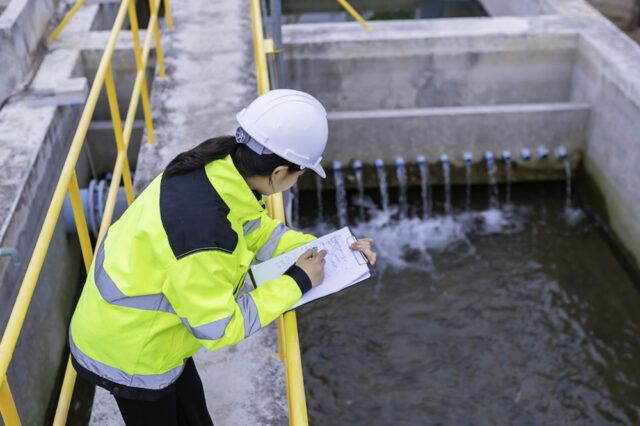
If you’re looking for precision, reliability, and minimal maintenance, Area Velocity Measurement represents a quantum leap forward. This technology is rapidly becoming the preferred choice for municipalities, industrial operators, and environmental agencies worldwide.
How Area Velocity Technology Works

AVM measures two critical parameters simultaneously:
Velocity: Ultrasonic sensors measure the speed of water flowing through the channel using transit time or Doppler technology
Area: Separate sensors measure the liquid depth; combined with channel geometry, this calculates the cross-sectional area
The flow rate is then calculated using the fundamental continuity equation: Q = V × A (Flow = Velocity × Area)
Transit Time Technology
Advanced ultrasonic transducers send sound pulses downstream and upstream. The difference in travel time reveals the average fluid velocity. Modern systems can use 2, 3, or 4 sensor paths, with higher path counts delivering greater accuracy in irregular channels.
Advantages:
– Works in both clean and dirty water (up to 30% suspended solids)
– No moving parts—zero wear or fouling
– Highly accurate across wide flow ranges
– Multi-path systems adapt to channel geometry
Best for: Municipal wastewater, stormwater, irrigation, industrial discharges, and rivers.
Doppler Technology
Doppler sensors emit ultrasonic pulses that reflect off particles and bubbles in the water. The frequency shift reveals velocity directly.
Advantages:
– Excellent for highly turbulent or aerated flows
– Cost-effective single-sensor solution
– Ideal for rapidly changing conditions
Best for: Sewage systems, wastewater plants, particle-laden flows.
Considerations: Works best with sufficient particle content; less accurate in very clean water.
Choosing Your Open Channel Flow Measurement Method
Your choice depends on several factors:
Flow Accuracy Requirements
- Regulatory compliance or billing? Choose AVM with modern ultrasonic technology (±1-2% achievable)
- Preliminary assessment or operational monitoring? Manning’s Equation or basic structures may suffice
- Continuous precision data? Modern AVM is the clear choice
Installation Constraints
- Limited upstream space? AVM avoids the need for weir pools
- Difficult retrofit situation? Portable area velocity meters offer temporary or permanent solutions
- Custom channel geometry? Multi-path AVM systems adapt to any shape
Water Conditions
- Clean water flows? Transit time AVM excels
- Highly turbulent or sediment-laden? Doppler AVM handles it better
- Significant aeration? Doppler technology is more robust
Budget and Maintenance
- Lowest capital cost? Traditional weirs remain economical
- Lowest operating cost? Modern ultrasonic AVM has no moving parts—minimal maintenance
- Long-term reliability? Modern systems outlast traditional structures by years
Why Avensys Chooses Modern Ultrasonic Solutions
At Avensys, we’ve moved beyond legacy technology. Our partnership with leading manufacturers in ultrasonic flow measurement gives us access to systems that deliver:
Accuracy: ±1-2% across diverse conditions, from clean municipal water to particle-laden stormwater
Reliability: No moving parts mean no fouling, clogging, or wear—equipment works year after year
Adaptability: Systems configured for pipes, rectangular channels, trapezoidal sections, or irregular geometries
Diagnostics: Real-time data logging, compliance-ready reports, and remote monitoring capabilities
Installation Efficiency: Faster deployment than traditional flumes or weirs; minimal civil works required
Whether you’re measuring influent flows at a wastewater plant, monitoring irrigation canals, tracking stormwater runoff, or managing environmental discharges, modern area velocity meters provide the accuracy, reliability, and data you need to make confident operational decisions.
Conclusion
Open channel flow measurement has evolved dramatically. While traditional methods—Manning’s Equation, weirs, and flumes—served for generations, today’s ultrasonic Area Velocity Measurement technology offers superior accuracy, lower maintenance, better data quality, and faster installation.
The right choice for your application depends on your specific requirements: accuracy needs, water conditions, installation constraints, and budget. But if precision, long-term reliability, and continuous monitoring are your priorities, modern AVM technology is the clear winner.
Ready to upgrade your flow measurement system? Contact Avensys Solutions to discuss which approach best fits your open channel application. Our team brings decades of industry expertise to help you select and deploy the right solution.
FAQ
 Q1: What is the difference between traditional weirs/flumes and modern area velocity meters?
Traditional structures require upstream space and accumulate sediments. Modern AVM uses ultrasonic technology for ±1-2% accuracy, no civil works, and continuous data logging.
Q2: How do ultrasonic flow meters improve open channel flow measurement?
They enable precise, non-contact velocity and depth measurement simultaneously. No moving parts means zero fouling, and they work reliably in clean or particle-laden water with real-time diagnostics.
Q3: Why is continuous open channel flow monitoring important?
Real-time visibility detects anomalies early, supports regulatory compliance, optimizes resource allocation, and reduces operational downtime.
Q4: How does Avensys support open channel flow measurement?
Avensys provides integrated ultrasonic solutions with remote monitoring and diagnostics. Our team helps select the right technology for your wastewater plant, irrigation system, or environmental monitoring application.
