A Division of The Hoskin Group. Canada’s Instrumentation Leader 


Choosing between level measurement technologies is one of the most common instrumentation decisions in Canadian industry, and one of the easiest to get wrong. Radar, ultrasonic, hydrostatic/differential pressure (DP), RF capacitance and magnetostrictive sensors all measure the same basic variable, yet each behaves very differently depending on the medium, the vessel and the environment. This guide compares the leading options for tanks, wells, sumps and pipelines so you can match the technology to the application rather than the other way around. It is part of our broader industrial water quality monitoring guide, which covers the full measurement chain from flow and sampling through to analytical instrumentation.
Level data drives inventory management, pump control, overfill prevention, dry-run protection and environmental compliance reporting. A transmitter that performs flawlessly on clean water in a calm tank may drift, drop out or fail outright when faced with foam, vapour, turbulence, coating or extreme temperatures. Because no single technology handles every condition, the selection process should start with the process conditions, not with a preferred product line.
Avensys Solutions supplies a full range of level measurement instruments for continuous and point level applications, including technologies from Ametek Drexelbrook and SOR, and supports them with application engineering across the water and wastewater, chemical, and pulp and paper sectors.
A non-contact radar level sensor emits microwave pulses from an antenna at the top of the vessel and calculates level from the time it takes the signal to reflect off the liquid surface. Because microwaves travel at a constant speed regardless of air temperature, pressure, vapour or dust, radar is largely immune to the atmospheric effects that trouble ultrasonic devices. Modern open air radar level transmitters handle long ranges, agitated surfaces and condensing environments, which makes them a strong default choice for chemical storage, lift stations, digesters and outdoor tanks exposed to Canadian temperature swings.
Radar’s main considerations are dielectric constant (very low-dielectric media reflect weakly), internal obstructions that create false echoes, and a typically higher purchase price than ultrasonic, although the gap has narrowed considerably in recent years.
An ultrasonic level transmitter works on the same time-of-flight principle but uses sound waves instead of microwaves. Ultrasonic level transmitters are economical, easy to commission and well proven in water and wastewater service: wet wells, clarifiers, chemical day tanks, flumes and open channels. Pairing an ultrasonic sensor with a flume or weir is also the classic approach to open channel flow measurement.
Because sound speed varies with air temperature and the signal can be absorbed or scattered, ultrasonic devices are sensitive to heavy foam, dense vapour, wind across open sumps and strong temperature gradients. Where those conditions exist, radar is usually the better non-contact option.
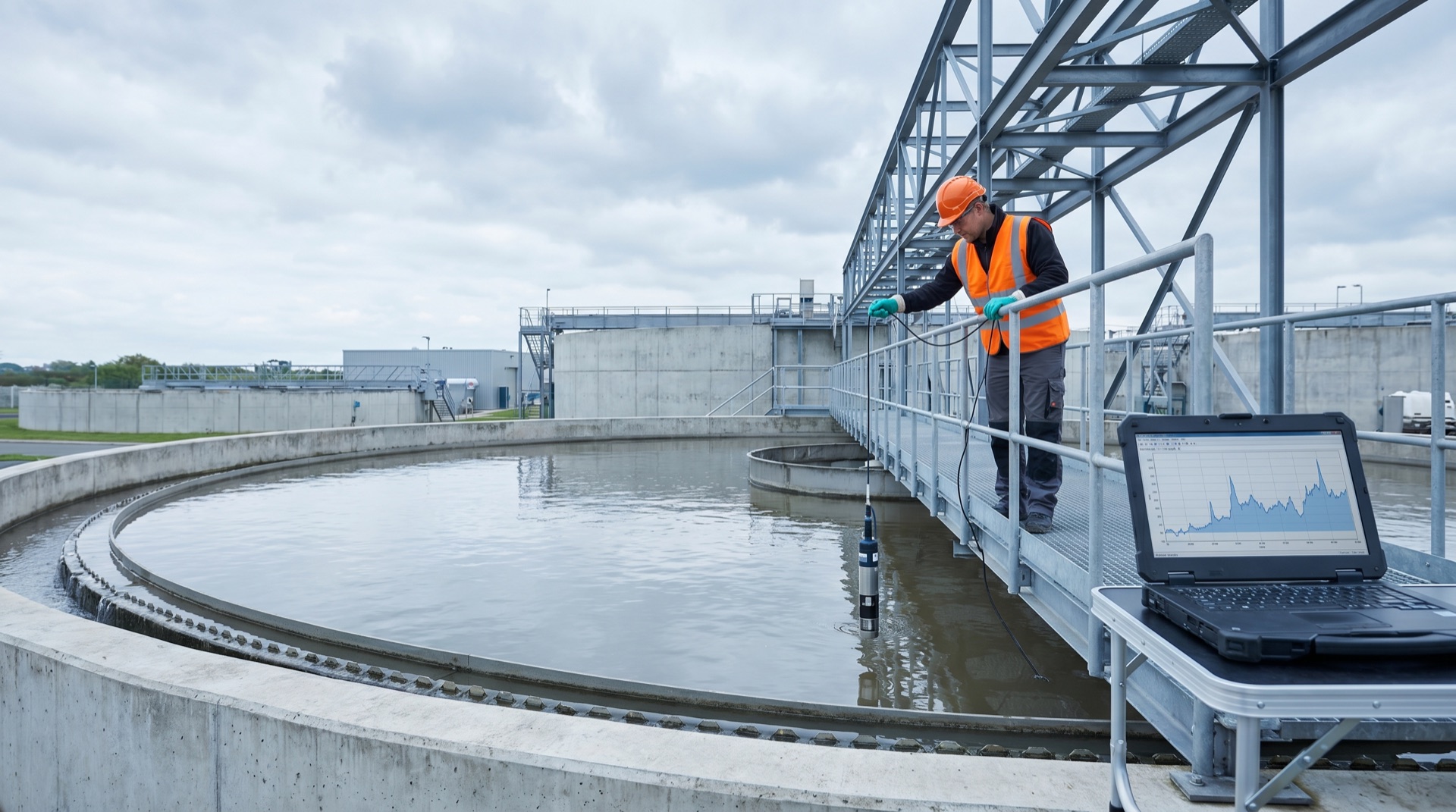
Hydrostatic measurement infers level from the pressure exerted by the liquid column above a sensor. Submersible hydrostatic pressure level transmitters are lowered directly into open tanks, wells, reservoirs and sumps, while DP transmitters mounted on closed vessels compare process pressure against a reference leg to compensate for headspace pressure. The technology is simple, robust and unaffected by foam, vapour or surface turbulence, which makes it popular for groundwater monitoring, lift stations and tall narrow vessels.
The key caveat is that hydrostatic readings depend on liquid density: if specific gravity changes with temperature or composition, the inferred level shifts with it. Sensor fouling in dirty media and condensation in reference legs are the other classic maintenance items.
RF (radio frequency) technology measures the change in electrical capacitance or admittance between a probe and the vessel wall as the medium rises and falls. RF level transmitters excel in applications that defeat other technologies: sticky and coating media, slurries, interfaces between two liquids, foams and many bulk solids. Ametek Drexelbrook is well known for coating-rejection RF designs, and the Ametek Drexelbrook level instrument line available through Avensys covers both continuous transmitters and point level switches built on this principle.
RF devices are contact instruments, so probe length, material compatibility and process temperature must be specified correctly, and calibration is tied to the electrical properties of the medium.
Magnetostrictive transmitters use a float containing a magnet that travels along a rigid or flexible waveguide; the electronics measure the precise position of the float to deliver high-resolution, high-accuracy level data. This makes magnetostrictive technology a favourite for inventory and custody-type measurements, interface detection with dual floats, and clean-liquid applications where repeatability matters more than tolerance for fouling. Like all float-based devices, it is best suited to relatively clean media that will not gum up float travel.
Not every point in the process needs a continuous reading. Level switches provide a discrete output at a fixed point, high level, low level or both, and remain the backbone of overfill protection, pump protection and alarm circuits. SOR float and displacer switches and Ametek Drexelbrook RF point level switches are widely used as independent safeguards layered on top of a continuous transmitter, so a single instrument failure never leaves a tank unprotected. A common and economical architecture is one continuous transmitter for control and trending, plus independent switches for high-high and low-low protection.
| Technology | Contact? | Strengths | Watch Out For | Typical Applications |
|---|---|---|---|---|
| Radar (non-contact) | No | Unaffected by vapour, temperature, pressure; long range; handles turbulence | Low-dielectric media; false echoes from internal structures | Chemical storage, digesters, lift stations, outdoor tanks |
| Ultrasonic | No | Economical; simple setup; proven in water/wastewater | Foam, dense vapour, temperature gradients, wind | Wet wells, clarifiers, day tanks, open channel flow |
| Hydrostatic / DP | Yes | Simple, rugged; immune to foam and surface conditions | Density changes; sensor fouling; reference leg upkeep | Wells, reservoirs, sumps, pressurized vessels |
| RF capacitance / admittance | Yes | Handles coating, sticky media, slurries, interfaces, solids | Probe specification; medium electrical properties | Sludge, slurries, interface, point level switching |
| Magnetostrictive | Yes | Very high accuracy and repeatability; interface capable | Requires clean media; float fouling | Inventory measurement, clean liquids, interface |
| Level switches (point) | Varies | Simple, reliable, independent protection layer | Single-point only; needs periodic proof testing | Overfill protection, pump dry-run protection, alarms |
If the level point feeds a pumping or dosing loop, technology choice should also be coordinated with your flow instrumentation; our comparison of electromagnetic, ultrasonic and mechanical liquid flow meters covers that side of the loop. For compliance points where level controls a sampler or monitoring station, see our guide to automated water sampling systems.
Regulatory context matters too. Facilities reporting under CEPA 1999, the NPRI or provincial wastewater frameworks rely on level instrumentation for overflow detection and containment monitoring; always confirm specific monitoring obligations with the relevant authority, since requirements vary by jurisdiction and permit.
Level rarely stands alone. In most plants it works alongside flow, sampling and analytical instruments as part of a complete industrial water quality monitoring program, and selecting it within that bigger picture, supported by the broader Avensys process instrumentation portfolio, avoids costly mismatches between devices that have to work together.
Both are non-contact time-of-flight devices, but radar uses microwaves while ultrasonic uses sound. Microwaves are unaffected by air temperature, vapour and pressure, so a radar level sensor performs better in condensing, vapour-heavy or temperature-variable environments. An ultrasonic level transmitter is typically more economical and entirely adequate for clean, calm applications such as water and wastewater wet wells and day tanks.
Use level switches wherever you need a simple, highly reliable action at a fixed point: high-level alarms, overfill shutdowns and pump dry-run protection. Best practice is to keep protective switches independent of the continuous transmitter so that one instrument failure cannot disable both control and protection.
Yes. Submersible hydrostatic pressure level transmitters are a standard solution for open tanks, wells, reservoirs and sumps because they ignore foam, wind and surface turbulence. Just remember that the reading depends on liquid density, so significant density changes will shift the inferred level, and the sensor should be accessible for periodic cleaning in dirty media.
RF capacitance and admittance instruments shine in coating, sticky and viscous media, slurries, foams, liquid-liquid interfaces and many bulk solids, conditions that often defeat ultrasonic and float-based devices. Coating-rejection designs such as those from Ametek Drexelbrook are specifically engineered to keep reading accurately as material builds up on the probe.
Foam absorbs and scatters ultrasonic signals, so foamy applications usually call for hydrostatic measurement, RF probes or, depending on foam density and thickness, radar. The right answer depends on whether you want to measure the liquid surface beneath the foam or the top of the foam itself, which is a useful question to settle with an application engineer before specifying hardware.
Avensys Solutions is a proud member of The Hoskin Group, supporting Canadian industry with instrumentation supply, technical service and systems integration.
Avensys Solutions helps Canadian plants specify, install and maintain the right level instrumentation the first time. Our team backs every technology we supply, from radar and ultrasonic transmitters to Ametek Drexelbrook RF instruments and SOR level switches, with value-added services:
Explore our instrumentation services or contact our team to discuss your tank, well or pipeline level application.

Our goal is to offer broad capabilities, competitive pricing, exceptional quality and outstanding service to each and every customer across Canada.
A Division of The Hoskin Group. Canada’s Instrumentation Leader
©2026 Avensys · Powered by Canibuy™